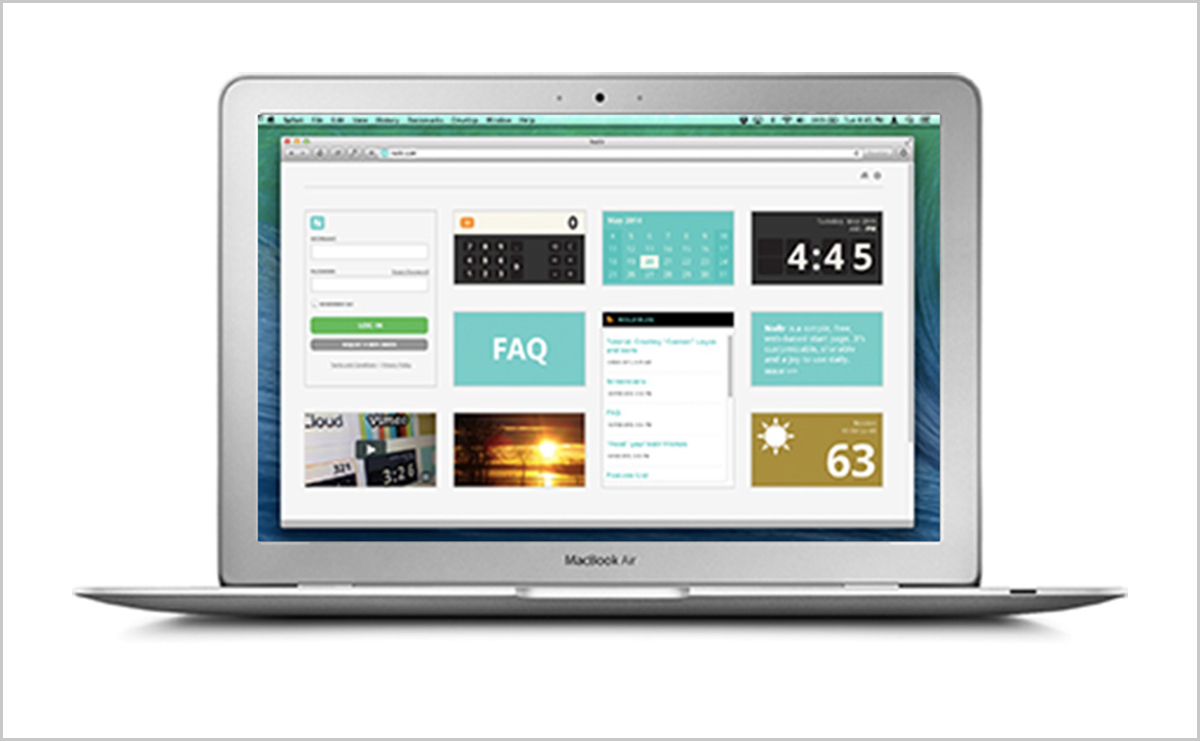
Knoller (formally Nollr) is a customizable and responsively-designed web-layout system for sortable and filterable portfolios and start pages. Knoller is based on the concept of Knolling. I first started sketching ideas for Knoller when I was asked to help design a flexible portal for an architecture firm’s intranet.
With the Knoller project, the original goals were to explore [the the time new] possibilities made available in HTML 5 and other responsive web technologies and approaches. To support this interest, I took an HTML 5 course with Boaz Sender in 2011.
Knoller aimed to provide a simple, modular, and flexible tile-based format for the web. The Knoller page is comprised of fixed [272px in version 6] width frames that can contain a variety of content and media: images, links, videos, and interactive widgets [placed within iFrames]. As part of this project, we custom-designed several “responsive widgets” (mini applications that scale up and down in size). These include:
- The Knoller Weather Widget (designed by Oak Studios)
- The Knoller Calculator (designed by Oak Studios)
- The Knoller Clock (designed by Oak Studios)
- The Knoller Calendar (designed by Jeff Vlahos)
- The Knoller Color Picker (designed by Jeff Vlahos)
- The Knoller Responsive Audio Player (designed by Dan Vlahos)
These Knoller widgets also served as an early exploration into possibilities around dynamic web content—on the Weather Widget, for instance, the color of the background changes (light to dark) depending on the time of day and (warm to cool) based on the outside air temperature.
The term “knolling” is used to describe the orderly arrangement of tools and other items. This usage seems to have been popularized by the American artist Tom Sachs. As far as I know, the first person to use the term “knolling” was Andrew Kromelow, who once worked as a janitor at Frank Gehry’s furniture store. As the story goes, at the time, Gehry was designing for the American modern furniture brand Knoll. At the end of the workday, Kromelow would go through the store and find any tools that were left out. Kromelow would then rearrange the tools on a flat surface so they were at right angles to one another. He called this knolling, because it reminded him of the angles in Florence Knoll’s furniture pieces. Sach’s also worked in Frank Gehry’s furniture shop and this is where he likley picked up on the term. Sachs later adopted the phrase “Always be Knolling” (abbreviated as ABK) as a mantra for his studio (in direct reference to Blake’s infamous line “Always be Closing” in the 1992 American drama film Glengarry Glen Ross. “Always be Knolling” appears in Sack’s 2009 studio manual titled 10 Bullets.
Dan Vlahos and—
Jeff Vlahos, Director of User Experience
Facta Studio, Web Development
Oak Studios, Knoller Widgets
More FILED IN: Interaction Design